Pam mae CNC yn Rhoi Mantais Gystadleuol i Luthiers?
Mae adeiladu gitarau traddodiadol yn gofyn am gannoedd o oriau fesul offeryn. Gall gwddf gitâr acwstig sengl, wedi'i gerfio a'i siapio â llaw, gymryd 3 diwrnod llawn. Gyda Llwybrydd pren CNC, mae'r un gwddf yn cael ei beiriannu mewn llai na 4 awr gan gynnwys y gosodiad. Mae'r fantais cyflymder hon yn cyfuno ar draws rhediadau swp, gan ganiatáu i weithdai bach gyflawni archebion personol a chynhyrchu rhestr eiddo ar yr un pryd.
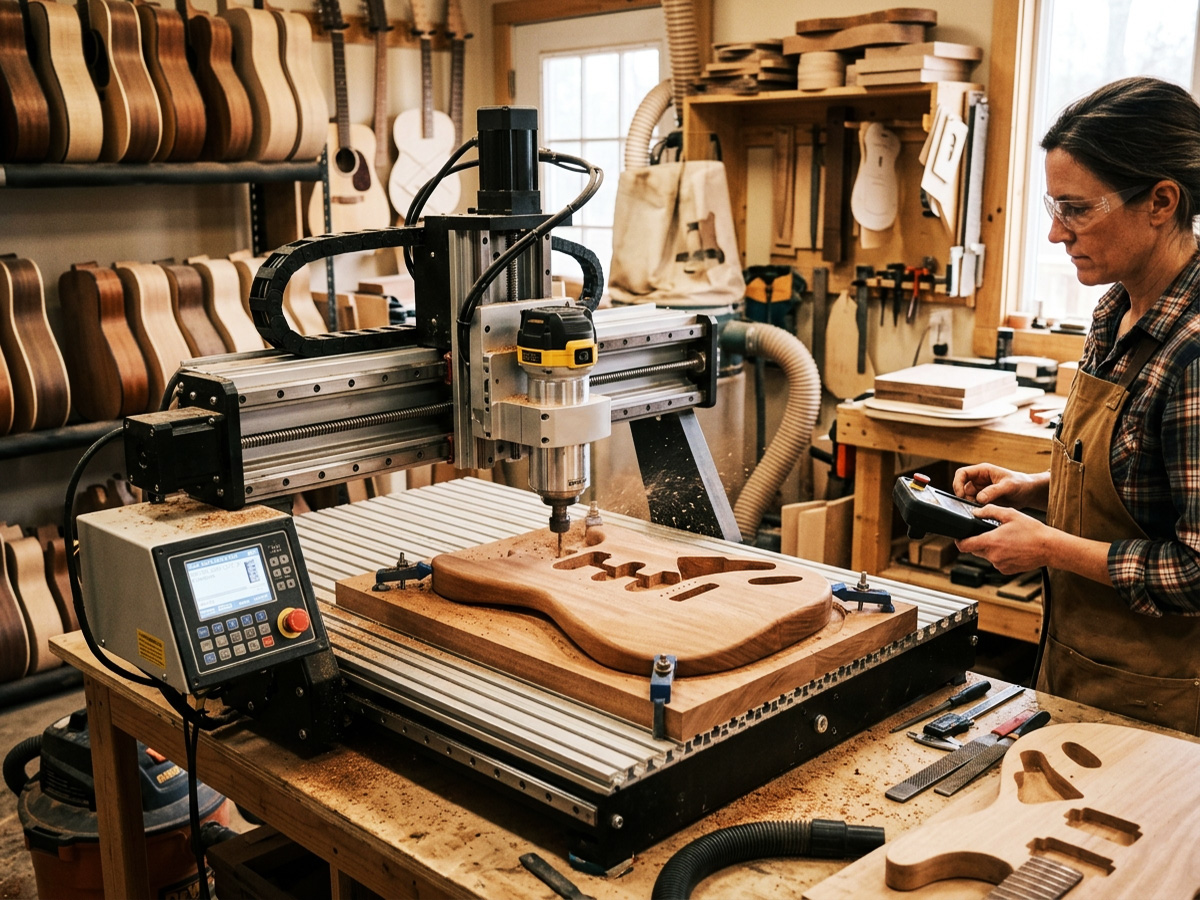
Mae cerfio CNC hefyd yn dileu'r anghysondeb sy'n plagio offerynnau a adeiladwyd â llaw. Mae pob ceudod, radiws a chyfuchlin yn cael ei efelychu o ffeiliau CAD wedi'u gwirio, felly mae'r 10fed gitâr oddi ar y llinell yn swnio ac yn chwarae'n union yr un fath â'r cyntaf.
| Mesur | Adeiladwyd â Llaw | Llwybrwyd CNC |
|---|---|---|
| Amser siapio'r corff | 6-8 oriau | Cofnodion 45-90 |
| Amser cerfio gwddf | 2–3 diwrnod | 3-4 oriau |
| Goddefgarwch dimensiwn | ±0.5 mm nodweddiadol | ±0.05 mm yn gyraeddadwy |
| Cyfradd gwastraff deunydd | 15-25% | 5-10% |
| Cysondeb swp | Amrywiol | Yn union yr un fath fesul ffeil CAD |
Galw Cynyddol am Rannau Gitâr a Wnaed gan CNC
Roedd gwerth marchnad gitarau byd-eang tua $12.7 biliwn yn 2025 a rhagwelir y bydd yn tyfu ar gyfradd twf blynyddol gyfansawdd o tua 7.5% tan ddechrau'r 2030au. Mae offerynnau personol a bwtîc yn cynrychioli un o'r segmentau sy'n ehangu gyflymaf, gyda chyfrolau archebion mewn siopau personol yn cyrraedd lefelau digynsail.
Mae marchnadoedd ar-lein fel Reverb, Etsy, ac eBay wedi ei gwneud hi'n hynod o hawdd i adeiladwyr bach gyrraedd prynwyr byd-eang. Mae gwerthiant gitarau ail-law a bwtîc yn unig yn cynrychioli marchnad flynyddol gwerth biliynau o ddoleri sy'n tyfu dros 5% y flwyddyn.
• Mae tua 45–49% o chwaraewyr gitar newydd ers 2020 yn fenywod, gan ehangu sylfaen y prynwyr yn sylweddol
• Gitarau lefel mynediad o dan $200 cyfrif am tua 60% o werthiannau unedau yn creu galw enfawr am gydrannau fforddiadwy, wedi'u gwneud yn dda
• Mae gwerthiant gitarau ar-lein bellach yn cynrychioli 38–40% o bob pryniant gitâr yn yr Unol Daleithiau
• Mae'r galw am addasu wedi cynyddu'n sydyn, gyda phrynwyr yn chwilio am siapiau corff, mewnosodiadau a gorffeniadau personol
Beth Allwch Chi Ei Wneud a'i Werthu: Catalog Cynnyrch gyda Phrisio?
Nid yw busnes gwneud gitarau CNC wedi'i gyfyngu i offerynnau cyflawn. Mae gwerthiant cydrannau, ategolion, a chynhyrchion atodol yn agor nifer o ffrydiau refeniw. Isod mae catalog cynnyrch gyda phrisiau bras fesul uned ar gyfer eitemau a gynhyrchwyd gan CNC.
| Dewisiwch eich eitem | Deunydd | Amrediad pris | Sianel Werthu |
|---|---|---|---|
| Corff gitâr drydan (gwag) | Gwernen, Onnen, Basswood | $ 60 - $ 150 | Adlais, eBay, archebion uniongyrchol |
| Cit corff gitâr acwstig | Sbriws, Mahogani | $ 120 - $ 300 | Manwerthwyr cyflenwi luthier |
| Gwddf gitâr (masarn/rhosyn) | Masarn, Mahogani | $ 50 - $ 180 | Adlais, Etsy, cyfanwerthu |
| Bwrdd ffret / byseddfwrdd | Eboni, Rhoswydd, Masarn | $ 20 - $ 60 | Cyflenwad luthier, yn uniongyrchol |
| Gorchudd pen / finer | Eboni, Pren caled egsotig | $ 8 - $ 25 | Etsy, fforymau luthier |
| Mewnosodiadau personol (bwrdd ffret/rhosét) | MOP, Abalone, Acrylig | $ 15 - $ 80 | Uniongyrchol, Adlais, Etsy |
| Gwarchodwyr Pick | Acrylig, Pren, Cellwloid | $ 10 - $ 40 | Amazon, Reverb, uniongyrchol |
| Plectrau gitâr (wedi'u brandio'n arbennig) | Acrylig, Pren, Corn | $2-$8 yr un | Etsy, nwyddau band, cyfanwerthu |
| Standiau gitâr / crogfachau wal | Pren caled, Pren haenog | $ 25 - $ 75 | Amazon, Etsy, manwerthwyr cerddoriaeth |
| Mewnosodiadau cas gitâr personol | Ewyn + cragen pren haenog | $ 40 - $ 120 | Uniongyrchol, Adlais |
| Jigiau a thempledi ar gyfer adeiladwyr | MDF, Acrylig | $ 15 - $ 50 | Fforymau Luthier, Etsy |
Dewis y Llwybrydd CNC Cywir ar gyfer Adeiladu Gitâr
Mae dewis y peiriant cywir yn dibynnu ar eich cyfaint cynhyrchu, eich gweithle a'ch cyllideb. Mae llwybrydd cryno 600 × 900 mm yn trin cyrff a gyddfau gitâr unigol yn dda, tra bod llwybrydd maint llawn 4x8 Llwybrydd pren CNC yn caniatáu ichi nythu rhannau lluosog ar un ddalen, gan wneud y mwyaf o'r trwybwn ar gyfer cynhyrchu swp.
Ar gyfer gweithdai sy'n torri gwahanol broffiliau (ceudodau corff, pocedi gwddf, pocedi mewnosod), Llwybrydd CNC ATC gyda newidydd offer awtomatig yn dileu cyfnewid bitiau â llaw ac yn arbed amser sylweddol ar draws rhediadau aml-weithrediad. Mae gwerthyd 2.2–3.0 kW yn darparu digon o bŵer ar gyfer coed caled fel masarn a mahogani. Ar gyfer gweithrediadau masnachol mwy, mae gwerthyd 4.5 kW neu uwch wedi'i pharu â dal i lawr gwactod yn darparu perfformiad gradd ddiwydiannol.
Ffurfweddiadau Peiriant Argymhelliedig
| Graddfa | Maes Gwaith | gwerthyd | gorau Ar gyfer |
|---|---|---|---|
| Hobi / Busnes Newydd | 600 × 900 mm | 1.5-2.2 kW | Cynhyrchu corff/gwddf sengl, creu prototeipiau |
| Gweithdy Bach | 1300 × 2500 mm | 3.0-4.5 kW | Cyrff swp, torri nythu, gwneud jigiau |
| Siop Cynhyrchu | 1500 × 3000 mm+ | 4.5–9.0 kW + ATC | Gweithgynhyrchu cyfaint uchel, nythu aml-ran |
Argymhellion Deunydd ar gyfer Rhannau Gitâr CNC
Mae dewis pren tôn yn effeithio'n uniongyrchol ar ansawdd sain, ymarferoldeb, a gwerth manwerthu. Isod mae'r deunyddiau mwyaf cyffredin a ddefnyddir mewn cynhyrchu gitarau CNC, ynghyd â'u cymwysiadau nodweddiadol.
• Gwernen / Basswood: Ysgafn, hawdd ei beiriannu, ardderchog ar gyfer cyrff gitarau trydan. Yn cael ei ffafrio gan adeiladwyr arddull Fender.
• Onnen (Onnen y Gors): Graen agored, tôn llachar. Poblogaidd ar gyfer adeiladau arddull Telecaster a Stratocaster.
• Mahogani: Tôn gynnes, gyfoethog gyda chynhaliaeth ragorol. Safonol ar gyfer cyrff arddull Les Paul a chefn/ochrau gitâr acwstig.
• Masarn: Trwchus a llachar. Wedi'i ddefnyddio ar gyfer gyddfau, byrddau ffretiau, a thopiau corff. Angen offer miniog a chyfraddau bwydo arafach ar CNC.
• Sbriws: Y pren bwrdd sain dewisol ar gyfer gitarau acwstig. Ysgafn, stiff, ac atseiniol.
• Eboni / Rhoswydd: Pren byseddfwrdd premiwm. Defnyddir offer carbid trwchus a chyfoethog o olew a chyflymderau gwerthyd is.
Ychwanegu Gwerth gyda Gwaith Ysgythru a Mewnosod Laser
Mae mewnosodiadau ffretfwrdd, rhosédau, a logos penstock yn ychwanegiadau gwerth uchel sy'n gosod gitarau wedi'u teilwra ar wahân i offerynnau a gynhyrchir yn dorfol. Mae llwybrydd CNC yn trin torri pocedi ar gyfer mewnosodiadau cregyn ac acrylig, tra bod peiriant engrafiad laser yn ychwanegu engrafiad addurniadol cymhleth, rhifau cyfresol, a logos brand yn uniongyrchol ar arwynebau pren, asgwrn, neu acrylig.
Cyfuno a Llwybrydd CNC gydag ehangu laser yn rhoi'r gallu i'ch gweithdy gynnig offerynnau wedi'u haddasu'n llawn am brisiau premiwm. Mae llawer o fusnesau luthier llwyddiannus yn adrodd bod gwasanaethau mewnosod ac ysgythru personol yn unig yn cynhyrchu 20–30% o gyfanswm y refeniw.
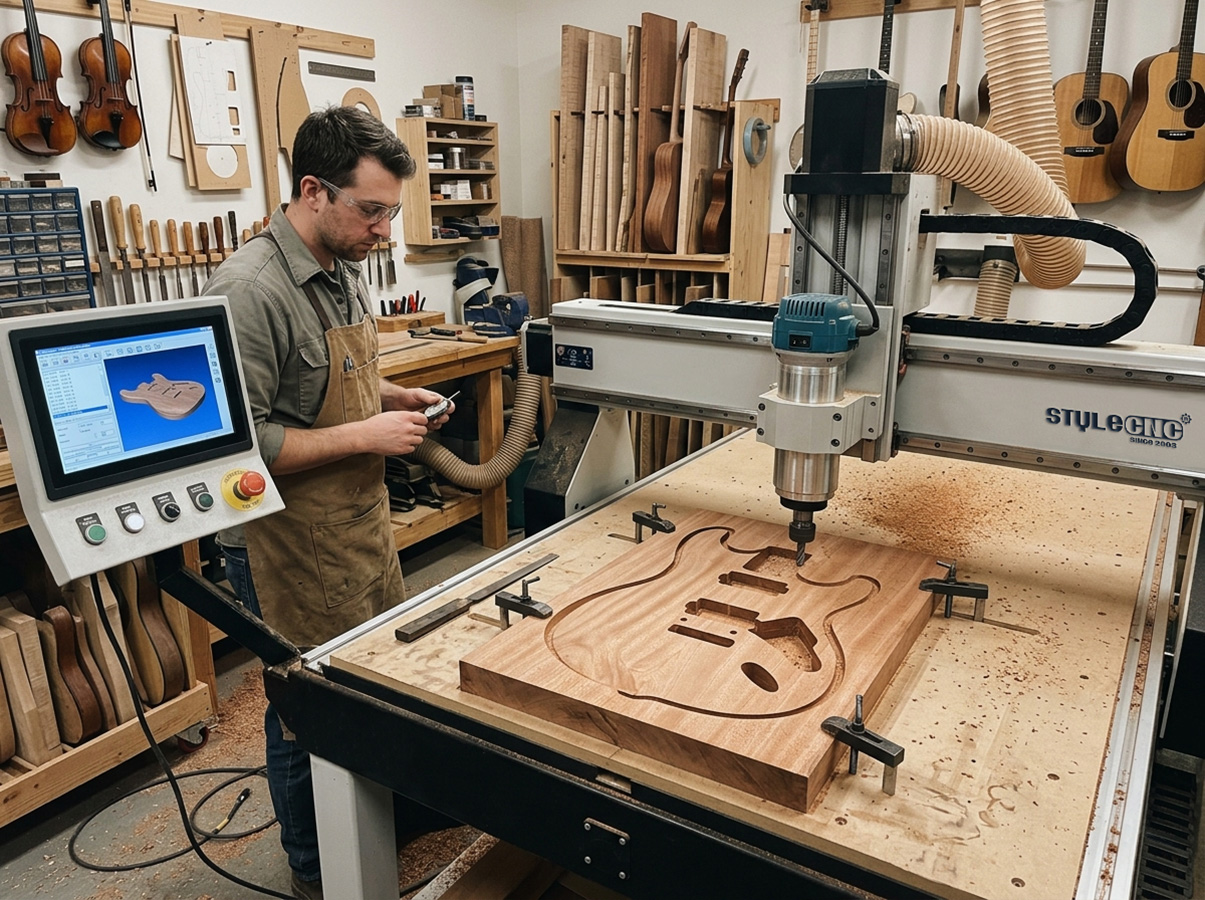
ROI Busnes: Dadansoddiad Buddsoddiad vs. Enillion
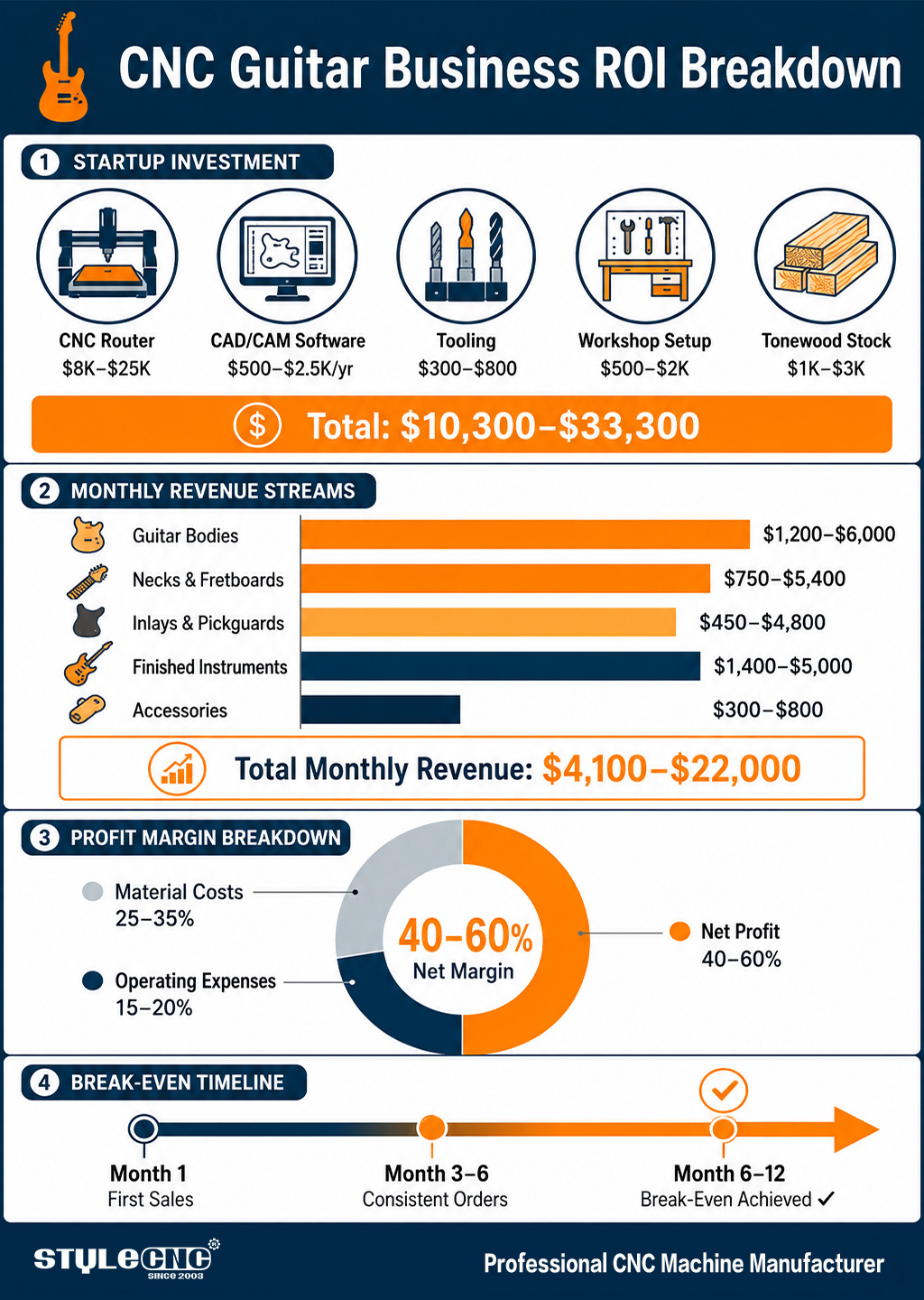
Mae deall y darlun ariannol yn hanfodol cyn lansio. Dyma ragamcan realistig o ROI yn seiliedig ar weithdy bach sy'n cynhyrchu cydrannau gitâr CNC ac offerynnau gorffenedig.
| Eitem Buddsoddi | Amcangyfrif o'r Gost |
|---|---|
| Llwybrydd CNC (3-echel, ATC, 1300 × 2500 mm) | $ 8,000 - $ 25,000 |
| Meddalwedd CAD/CAM (Fusion 360, VCarve, ac ati) | $500–$2,500/blwyddyn |
| Offerynnu (melinau pen, trwyn pêl, darnau V) | $ 300 - $ 800 |
| Casglu llwch a sefydlu gweithdy | $ 500 - $ 2,000 |
| Stoc pren tôn cychwynnol | $ 1,000 - $ 3,000 |
| Cyfanswm y Buddsoddiad Cychwyn Busnes | $ 10,300 - $ 33,300 |
Rhagamcaniad Refeniw Misol (Gweithdy Bach)
| Ffrwd Refeniw | Unedau / Mis | Refeniw Misol |
|---|---|---|
| Cyrff gitâr (trydanol) | 20-40 | $ 1,200 - $ 6,000 |
| Gwddfau a byrddau ffret | 15-30 | $ 750 - $ 5,400 |
| Mewnosodiadau a phicgwarchodwyr personol | 30-60 | $ 450 - $ 4,800 |
| Offerynnau gorffenedig | 2-5 | $ 1,400 - $ 5,000 |
| Ategolion (pigau, stondinau, jigiau) | 50–100 + | $ 300 - $ 800 |
| Cyfanswm y Refeniw Misol Amcangyfrifedig | - | $ 4,100 - $ 22,000 |
Gyda chostau deunyddiau ar gyfartaledd yn 25–35% o refeniw a threuliau gweithredu tua 15–20%, elw net o 40–60% yn gyraeddadwy ar gyfer busnesau gitâr CNC sy'n cael eu rheoli'n dda. Mae'r rhan fwyaf o weithdai'n cyrraedd mantoli o fewn 6–12 mis o gynhyrchu cyson.
Sut i Gyrraedd Eich Prynwyr
Mae gwerthu rhannau ac offerynnau gitâr wedi'u gwneud â CNC yn gofyn am ddull aml-sianel. Dyma'r strategaethau mwyaf effeithiol y mae adeiladwyr yn eu defnyddio i ddod o hyd i gwsmeriaid a'u cadw.
✓ Reverb.com – Y farchnad bwrpasol fwyaf ar gyfer offerynnau cerdd a rhannau. Ffioedd rhestru isel, ymddiriedaeth prynwyr adeiledig, ac SEO cryf ar gyfer rhannau gitâr.
✓ Etsy – Yn ddelfrydol ar gyfer mewnosodiadau personol, plectrwm brand, gorchuddion pen unigryw, ac ategolion crefftus.
✓ eBay / Amazon – Cyfaint uchel ar gyfer cyrff, gyddfau a phecynnau caledwedd safonol.
✓ Gwefan uniongyrchol gyda Shopify – Adeiladu eich brand, arddangos adeiladwaith wedi'i deilwra, a chipio elw uwch trwy werthu'n uniongyrchol i'r defnyddiwr.
✓ Manwerthwyr a dosbarthwyr cerddoriaeth – Partneriaethau cyfanwerthu ar gyfer siopau a chadwyni.
✓ Cymunedau cyflenwi luthier – Mae fforymau fel LMI, cymuned StewMac, a grwpiau cyfryngau cymdeithasol yn eich cysylltu ag adeiladwyr proffesiynol sydd angen cyflenwyr cydrannau dibynadwy.
Camgymeriadau Cyffredin i'w Osgoi
Mae cychwyn busnes gitâr CNC yn broses ddysgu. Dyma'r peryglon sy'n baglu'r rhan fwyaf o adeiladwyr newydd:
• Hepgor prototeipio: Gwnewch brawf-dorri mewn poplys neu MDF rhad bob amser cyn peiriannu coed tôn premiwm.
• Cyfraddau bwydo anghywir ar gyfer coed caled: Mae coed trwchus fel masarn ac eboni angen cyfraddau bwydo arafach ac offer carbid miniog i atal rhwygo allan.
• Anwybyddu casglu llwch: Mae llwch mân o bren tôn yn niweidio berynnau a rheiliau'r werthyd. Buddsoddwch mewn echdynnu priodol o'r diwrnod cyntaf.
• Dim proses rheoli ansawdd: Mesurwch bob swp gyda caliprau. Mae hyd yn oed drifft o 0.2 mm ar boced gwddf yn effeithio ar y gallu i chwarae.
• Rhoi pris is ar eich gwaith: Ystyriwch amser peiriant, deunydd, gorffen, cludo, a ffioedd marchnad cyn gosod prisiau.
• Gor-ddibynnu ar CNC yn unig: Mae'r tywodio terfynol, y gwaith ffretio, y gorffeniad a'r gosodiad yn parhau i fod yn brosesau â llaw. Mae CNC yn ymdrin â siapio garw a manwl gywir, nid yr adeiladwaith cyfan.
Dechrau Arni: Rhestr Wirio Cam wrth Gam
Dilynwch y dilyniant hwn i symud o'r syniad i'r gwerthiant cyntaf cyn gynted â phosibl.
1. Ymchwiliwch i'ch maes arbenigol: cyrff trydan, citiau acwstig, ategolion, neu'r tri.
2. Dewiswch ac archebwch eich llwybrydd CNC. Archwiliwch opsiynau o'r STYLECNC catalog llwybrydd CNC gwaith coed i gyd-fynd â'ch cyllideb a'ch nodau cynhyrchu.
3. Gosodwch feddalwedd CAD/CAM (Fusion 360, VCarve Pro, neu Aspire) a dysgwch lwybrau offer sy'n benodol i'r gitâr.
4. Dewch o hyd i bren tôn gan gyflenwyr ag enw da (Gilmer Wood, Cook Woods, neu felinau llifio lleol ar gyfer stoc wedi'i adfer).
5. Creu prototeip o'ch dyluniadau cyntaf mewn MDF neu boplys cyn ymrwymo i fylchau premiwm.
6. Sefydlu cyfrifon gwerthwyr ar Reverb, Etsy, a'ch siop Shopify eich hun.
7. Tynnwch luniau o'ch cynhyrchion a'u rhestru gyda manylebau manwl, rhywogaethau pren, a honiadau cywirdeb CNC.
8. Adeiladwch bresenoldeb ar y cyfryngau cymdeithasol (Instagram, YouTube, TikTok) yn dangos eich fideos adeiladu proses CNC, sy'n trosi'n hynod o dda.
Gwylio: Llwybrydd CNC yn Gwneud Corff Gitâr
Gwel a STYLECNC llwybrydd ar waith, yn siapio corff gitâr o bwlch pren crai. Gweld y fideo arddangos llawn: Llwybrydd CNC Corff Gitâr DIY.
Cwestiynau Cyffredin
Pa faint o lwybrydd CNC sydd ei angen arnaf i wneud gitarau?
Mae angen ardal waith o leiaf 600 × 900 mm ar gyfer trin cyrff a gyddfau unigol. Ar gyfer cynhyrchu swp a nythu dalennau, argymhellir bwrdd 1300 × 2500 mm neu fwy.
Faint mae'n ei gostio i gychwyn busnes gwneud gitarau CNC?
Mae gosodiadau lefel mynediad yn dechrau tua $10,000–$15,000 gan gynnwys y llwybrydd, meddalwedd, offer, a deunyddiau cychwynnol. Mae gweithdai gradd cynhyrchu fel arfer yn gofyn am $20,000–$35,000.
A allaf ddefnyddio CNC ar gyfer gitarau acwstig, nid trydan yn unig?
Ydw. Mae llwybryddion CNC yn peiriannu breichiau gitâr acwstig, blociau gwddf, rhosédau, platiau pont, a mowldiau corff. Mae llawer o luthiers acwstig yn defnyddio CNC ar gyfer yr holl gydrannau strwythurol ac yn cadw gwaith llaw ar gyfer lleisio a chydosod terfynol.
Pa feddalwedd CAD/CAM sy'n gweithio orau ar gyfer adeiladu gitarau?
Fusion 360, VCarve Pro, ac Aspire yw'r rhai mwyaf poblogaidd ymhlith adeiladwyr gitarau. Mae opsiynau am ddim fel FreeCAD yn gweithio ar gyfer proffiliau 2D sylfaenol, ond 3D fel arfer mae cerfio gwddf yn gofyn am Fusion 360 neu MeshCAM.
A yw adeiladu gitarau CNC yn broffidiol fel busnes ochr?
Yn hollol. Gall gwerthu dim ond 10–20 o gyrff a gyddfau gitâr y mis ar Reverb neu Etsy gynhyrchu $1,500–$4,000 mewn refeniw gyda 40–60% elw gan ei wneud yn incwm ochr hyfyw ochr yn ochr â swydd ddyddiol.
A yw CNC yn disodli crefftwaith â llaw wrth wneud gitarau?
Na. Mae CNC yn trin siapio manwl gywir, llwybro ceudodau, a thasgau ailadroddus. Mae tywodio terfynol, gwaith ffretio, gorffen, gosod ac archwilio ansawdd yn parhau i fod yn sgiliau llaw hanfodol sy'n diffinio enw da adeiladwr.